How Long Can a Thawed Turkey Stay in the Fridge?
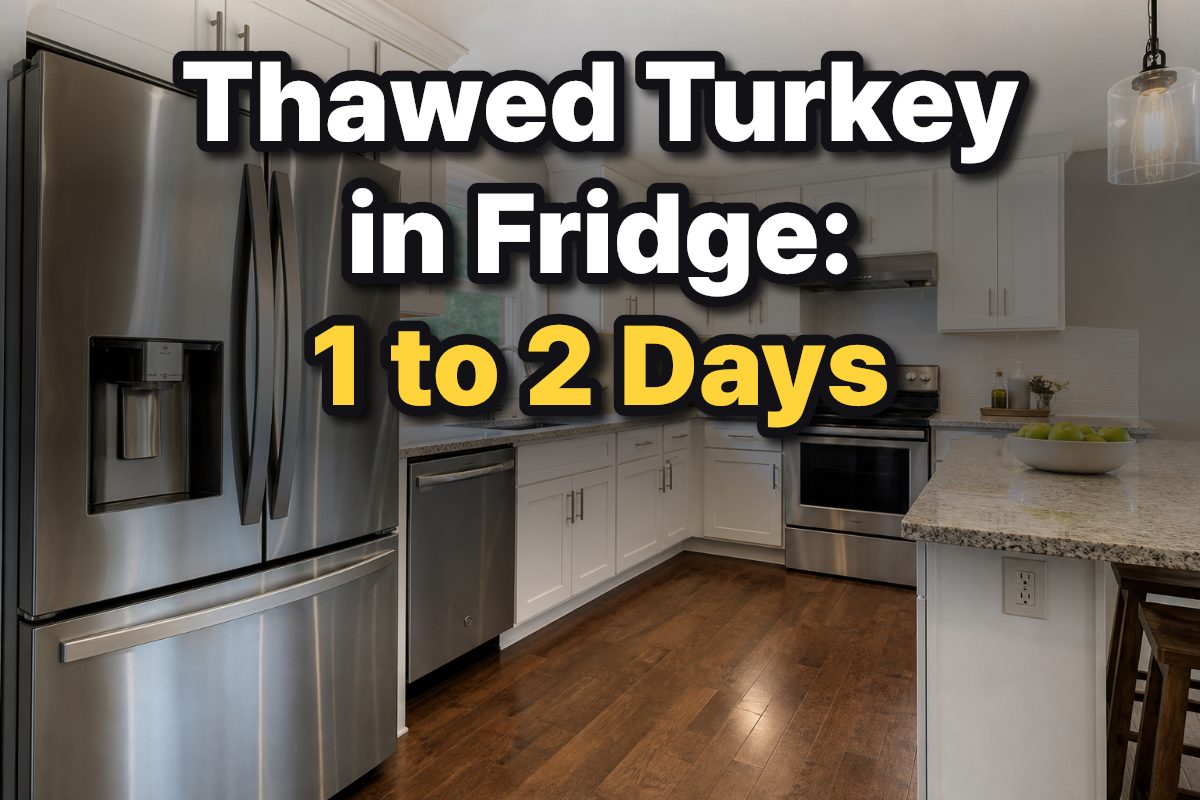
A turkey thawed in the refrigerator can stay there for 1 to 2 days after it is fully thawed before cooking. Keep the refrigerator at 40°F (4°C) or below; if you thaw the turkey in cold water or a microwave, cook it immediately instead of storing it raw for later.
Key Takeaways
- A refrigerator-thawed turkey has a 1-to-2-day window before cooking once it is fully thawed.
- USDA FSIS recommends thawing turkey in a refrigerator set at 40°F (4°C) or below, in cold water, or in a microwave—not on the counter.
- Only a turkey thawed in the refrigerator may be refrozen raw; refreezing can reduce quality.
- Place the turkey in a container on a low refrigerator shelf to contain juices and protect ready-to-eat foods.
- Smell and appearance cannot confirm that turkey is safe, because harmful bacteria may cause no visible or noticeable change.
Table of Contents
- How long can a thawed turkey stay in the fridge?
- Turkey storage times by type
- How to thaw a turkey safely
- How long does refrigerator thawing take by weight?
- What to do if your cooking plans change
- Signs thawed turkey has gone bad
- Common thawing and storage mistakes
- Frequently Asked Questions
- Key points to remember
How long can a thawed turkey stay in the fridge?
USDA Food Safety and Inspection Service (FSIS) guidance gives a refrigerator-thawed turkey 1 to 2 days in the refrigerator after it has completely thawed. This applies when the refrigerator stays at 40°F (4°C) or below. The time spent thawing in the refrigerator comes first; the 1-to-2-day storage period begins after thawing is complete.
Freezing does not sterilize poultry. Bacteria that were present before freezing can become active again as the turkey thaws, so the refrigerator’s cold temperature slows bacterial growth but does not stop it indefinitely. Plan the cooking day around the end of the thaw, rather than counting the whole thawing period as part of the 1-to-2-day window.
If plans change, a turkey thawed entirely in the refrigerator can be refrozen without cooking, according to USDA FSIS. Some quality may be lost after another freeze-and-thaw cycle. A turkey thawed in cold water or a microwave must be cooked immediately, so those methods do not provide the same option to hold the raw bird for another day.
Turkey storage times by type
Storage time depends on whether the turkey is raw, cooked, or deli meat. USDA FSIS lists the following refrigerator and freezer storage periods; pantry storage is not appropriate for these perishable turkey products.
| Turkey item | Fridge at 40°F (4°C) or below | Freezer at 0°F | Pantry |
|---|---|---|---|
| Fresh whole turkey | 1 to 2 days | 12 months | Not recommended |
| Fresh turkey parts | 1 to 2 days | 9 months | Not recommended |
| Ground turkey or giblets | 1 to 2 days | 3 to 4 months | Not recommended |
| Cooked turkey | 3 to 4 days | 4 months | Not recommended |
| Cooked turkey dishes | 3 to 4 days | 4 to 6 months | Not recommended |
| Turkey lunch meat, unopened | 2 weeks | 1 to 2 months | Not recommended |
| Turkey lunch meat, opened | 3 to 5 days | 1 to 2 months | Not recommended |
These freezer periods are storage guidance for quality as well as planning; food kept continuously frozen at 0°F remains safe for longer, though quality can decline. The table distinguishes cooked turkey from cooked turkey dishes because USDA FSIS gives them different freezer periods. For a thawed whole turkey, use the fresh whole turkey row for raw refrigerator and freezer storage guidance.
How to thaw a turkey safely
USDA FSIS recognizes three safe methods: refrigerator thawing, cold-water thawing, and microwave thawing. The refrigerator method takes the most planning but is the only one that allows the raw turkey to remain refrigerated for 1 to 2 days after thawing or to be refrozen without cooking.
- Refrigerator: Allow approximately 24 hours for every 4 to 5 pounds of turkey in a refrigerator at 40°F (4°C) or below. Set the wrapped turkey in a container to catch drips.
- Cold water: Keep the turkey in airtight packaging or a leak-proof bag and submerge it in cold water. Change the water every 30 minutes, and cook the turkey immediately once thawed.
- Microwave: Follow the microwave manufacturer’s directions for thawing. Cook the turkey immediately afterward because some areas may warm or begin to cook during microwaving.
Do not thaw turkey on a counter, in hot water, in a car, or anywhere its temperature cannot be controlled. The outside can warm into the 40–140°F (4–60°C) Danger Zone while the center is still frozen. Bacteria can multiply rapidly in this range, which is why a partly frozen center does not make counter thawing safe.
How long does refrigerator thawing take by weight?
USDA FSIS estimates about 24 hours of refrigerator thawing for each 4 to 5 pounds of turkey. The size ranges below show the planning window for a whole turkey; after it has completely thawed, allow another 1 to 2 days before cooking.
| Whole turkey weight | Approximate refrigerator thawing time | Latest planning point before cooking |
|---|---|---|
| 4 to 12 pounds | 1 to 3 days | Thawing time plus 1 to 2 days |
| 12 to 16 pounds | 3 to 4 days | Thawing time plus 1 to 2 days |
| 16 to 20 pounds | 4 to 5 days | Thawing time plus 1 to 2 days |
| 20 to 24 pounds | 5 to 6 days | Thawing time plus 1 to 2 days |
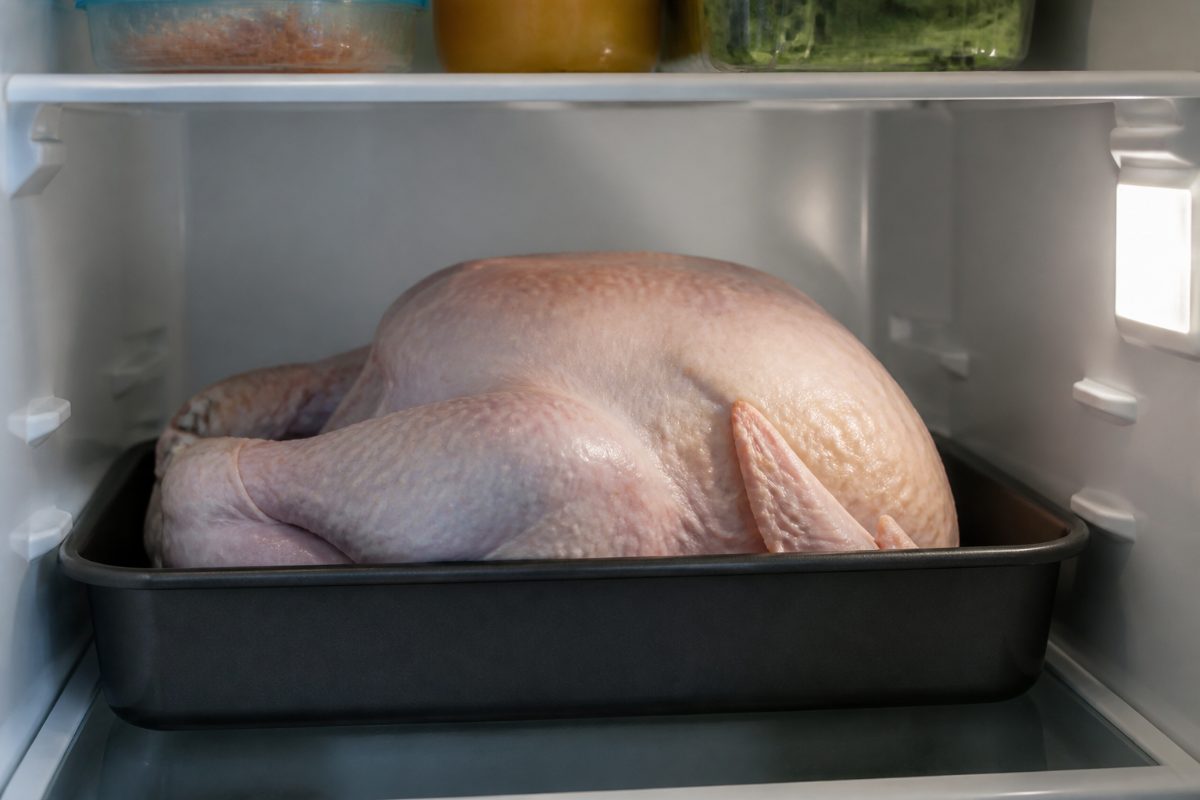
For example, a 12-to-16-pound bird may need 3 to 4 days to thaw in the refrigerator. Once fully thawed, it can remain chilled for 1 to 2 more days. Put the turkey in a rimmed container on a low shelf so that leaking poultry juices cannot drip onto produce or food that will be eaten without further cooking.
If the meal date is uncertain, refrigerator thawing gives the most flexibility. Cold-water thawing takes less time—about 30 minutes per pound in the University of Wyoming Extension guidance—but requires changing the water every 30 minutes and cooking the turkey as soon as it thaws.
What to do if your cooking plans change
For a turkey thawed in the refrigerator, choose between cooking it within the 1-to-2-day window and refreezing it raw while it is still within that period. USDA FSIS says refrigerator-thawed food may be refrozen without cooking, although quality can decline. If you used cold water or a microwave to thaw the bird, cook it immediately; do not put it back in the refrigerator to cook another day.
If the turkey has been left at room temperature for more than 2 hours, discard it. The University of Wyoming Extension also advises discarding perishable food left out for more than 1 hour when the temperature is above 90°F. These time limits matter even if the turkey still feels cool in the middle, because its outer surface can warm first.
Once cooked, refrigerate leftovers promptly in shallow containers. USDA FSIS lists cooked turkey and cooked turkey dishes for 3 to 4 days in the refrigerator; reheat leftovers to 165°F. Store turkey separately from stuffing and other foods so it cools more evenly and is easier to portion safely.
Signs thawed turkey has gone bad
A sour or unpleasant smell, a sticky or slimy texture, and dull gray or green discoloration are signs that raw turkey should be discarded. These changes can help identify obvious spoilage, but they are not a reliable safety test: harmful bacteria may be present without changing the food’s smell, appearance, or texture.
Use the storage timeline and temperature history as your main decision tools. If the turkey has exceeded the recommended refrigerator period or was left out beyond the safe time, do not taste it to check. Smelling or looking at the meat cannot undo unsafe handling or establish that it is safe to eat.
Common thawing and storage mistakes
- Starting the 1-to-2-day clock too early: That window is for the period after the turkey has fully thawed, not the entire time it spends thawing in the refrigerator.
- Leaving the bird uncovered on a shelf: Use a container to catch juices. This helps prevent raw poultry liquid from contacting other food.
- Assuming frozen means bacteria-free: Freezing stops bacterial growth while food remains frozen, but bacteria may grow again as it thaws.
- Using the counter to save time: The exterior can enter the Danger Zone even while the middle remains icy. Choose cold water or microwave thawing instead, and cook immediately afterward.
- Relying only on smell: Spoilage signs are useful clues, but harmful bacteria can cause no visible or sensory change. Follow the time and temperature guidance.
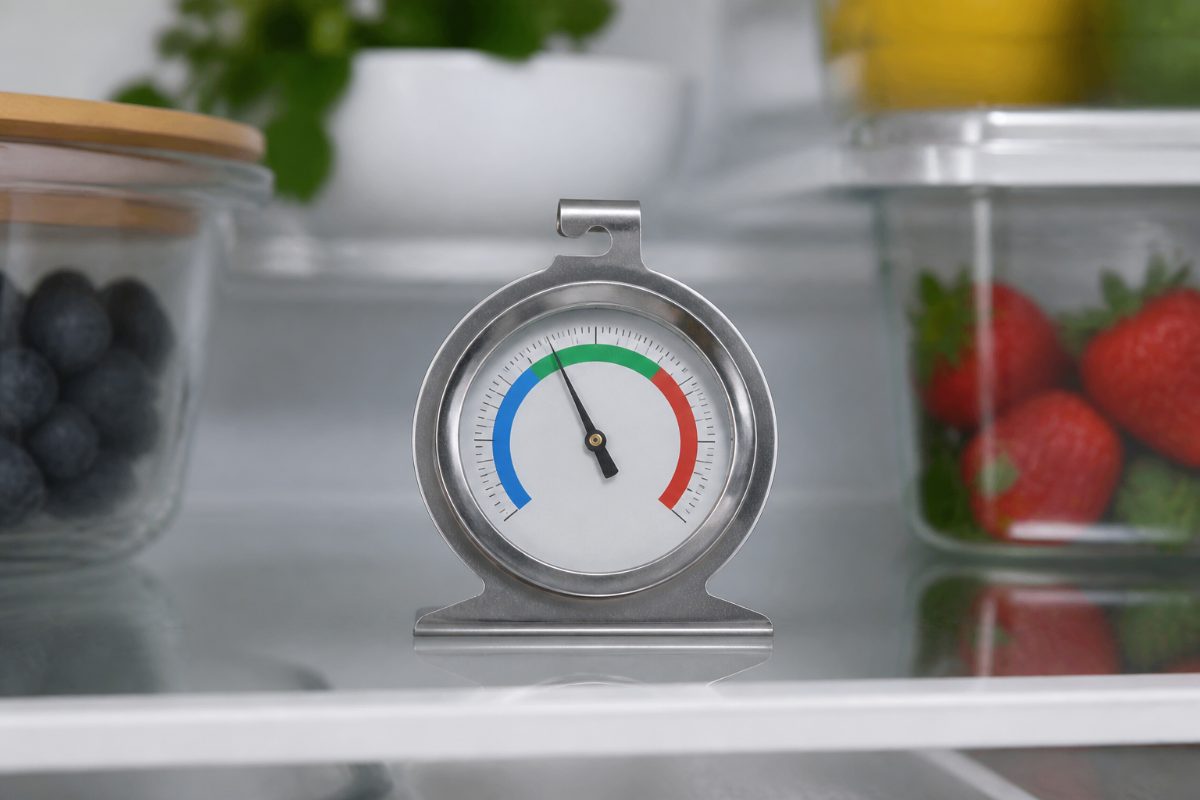
A refrigerator thermometer can help verify that the appliance is holding at 40°F (4°C) or below; a dial setting alone does not show the actual temperature. For thawing times, refreezing rules, and turkey storage periods, USDA FSIS’s “Turkey Basics: Safe Thawing” and “Turkey from Farm to Table” pages provide the specific guidance.
Frequently Asked Questions
Can I cook a turkey 3 days after it thawed in the fridge?
USDA FSIS gives a fully refrigerator-thawed turkey 1 to 2 days before cooking. If you cannot cook it within that period, refreeze it raw only if it was thawed in the refrigerator and has remained properly chilled.
Can I refreeze a turkey after thawing it in the refrigerator?
Yes. USDA FSIS says food thawed in the refrigerator may be refrozen without cooking, although the turkey may lose some quality. A turkey thawed in cold water or a microwave must be cooked immediately before any later freezing.
Can I thaw a turkey on the counter if the center is still frozen?
No. The outer portion can enter the 40–140°F (4–60°C) Danger Zone while the center remains frozen, allowing bacteria to multiply. Thaw it in the refrigerator, cold water, or a microwave instead.
How long can cooked turkey leftovers stay in the refrigerator?
USDA FSIS lists cooked turkey and cooked turkey dishes for 3 to 4 days in the refrigerator. Keep leftovers chilled, and reheat them to 165°F before serving.
Key points to remember
- After a turkey is fully thawed in the refrigerator, cook it within 1 to 2 days.
- Keep the refrigerator at 40°F (4°C) or below and catch raw poultry juices in a container.
- Cold-water and microwave-thawed turkey must be cooked immediately.
- Refreezing raw turkey is an option only after refrigerator thawing; expect possible quality loss.
- Time and temperature are more reliable safety guides than smell or appearance.
References
- How Long Does Turkey Last in the Fridge or Freezer? | Glad®
- FSHN14-13/FS260: Food Safety Tips for the Holiday Season
- Let's talk turkey - UNIVERSITY OF WYOMING EXTENSION
- How to safely store my turkey? | OSU Extension Service
- Turkey Basics: Safe Thawing | Food Safety and Inspection Service
- Turkey from Farm to Table | Food Safety and Inspection Service
- Your Safe Thanksgiving Guide | Food Safety and Inspection Service
- Turkey: Safe Thawing and Cooking: Food Safety - MN Dept. of Health
Information in this post was checked as of October 2026. Policies and prices may change, so please verify important details with official sources.


Comments
Post a Comment